- supergoods
- Posts
- 10 rules for brand collabs
10 rules for brand collabs
How to not mess it up

Brent Vrdoljak
February 12, 2026
There is a new growth hack in consumer goods.
Except it’s not that new and sometimes, it doesn’t work.
But there’s a playbook that every smart marketer should consider: brand collaborations.
And not just the “let’s do a giveaway on Instagram” type, but genuine collaboration, where two brands combine equity and distribution to create a product people actually want.
We’ve worked on loads of these recently and it’s finally gotten to the point where I’m like, damn it, I’m just going to write out everything I know.
Here are the 10 sacred rules to successful brand collaborations. Ignore at your peril.

This edition of supergoods is brought to you by Mind Control - the branding and packaging studio behind this newsletter.

Brand collabs are hard. Getting the packaging right is even harder.
How do you smoosh together two logos and brand identity elements in a way that feels cohesive and clear?
Not only that, but how do you manage the various stakeholders who each want their logo bigger?
Brand collaborations can make successful products, new revenue streams and rocket-fuel growth, but if you mess up the packaging, you mess it all up.
Thankfully, we know what’s up.
Let’s chat
There is power in getting brand collabs right
If you’re waiting for Disney to knock on your door and pitch you that Mickey Mouse hot sauce you’ve been dreaming of, you are probably still dreaming.
But if you have a tight list of brands you admire that you would one day love to work with, then this is for you.
Here are the 10 things you need to think through before you ship anything.
1. Decide on the job to be done
I’m not gonna give you any S.M.A.R.T goals bs, but you gotta think this through. What are you hoping to achieve with a partnership?
Trial spike? New channel? Premium price point? A range reset? New audiences?
If you can’t say what success looks like in one sentence, then it’s probably just content, not commerce.
2. The 3-second rule
This isn’t about picking up food off the floor (although that may apply). Can a shopper understand the product in 3 seconds? ‘Cause that’s all you got. And collabs die on the shelf when the concept needs an explanation.
If it’s not instantly obvious what it is and why it exists, then it’s back to the drawing board buddy.

Who doesn’t want chocolate bar inspired muesli bars? Clarity = tick. Source: Nestle.
3. Brands do not equal ‘product benefits’
“Two brands together” is not a product benefit. Don’t think about it from a framework of what’s good business for you both, but what can you create together?
The collaboration needs to create something that couldn’t exist without both parties. If you can’t get this right, it’s not worth doing.
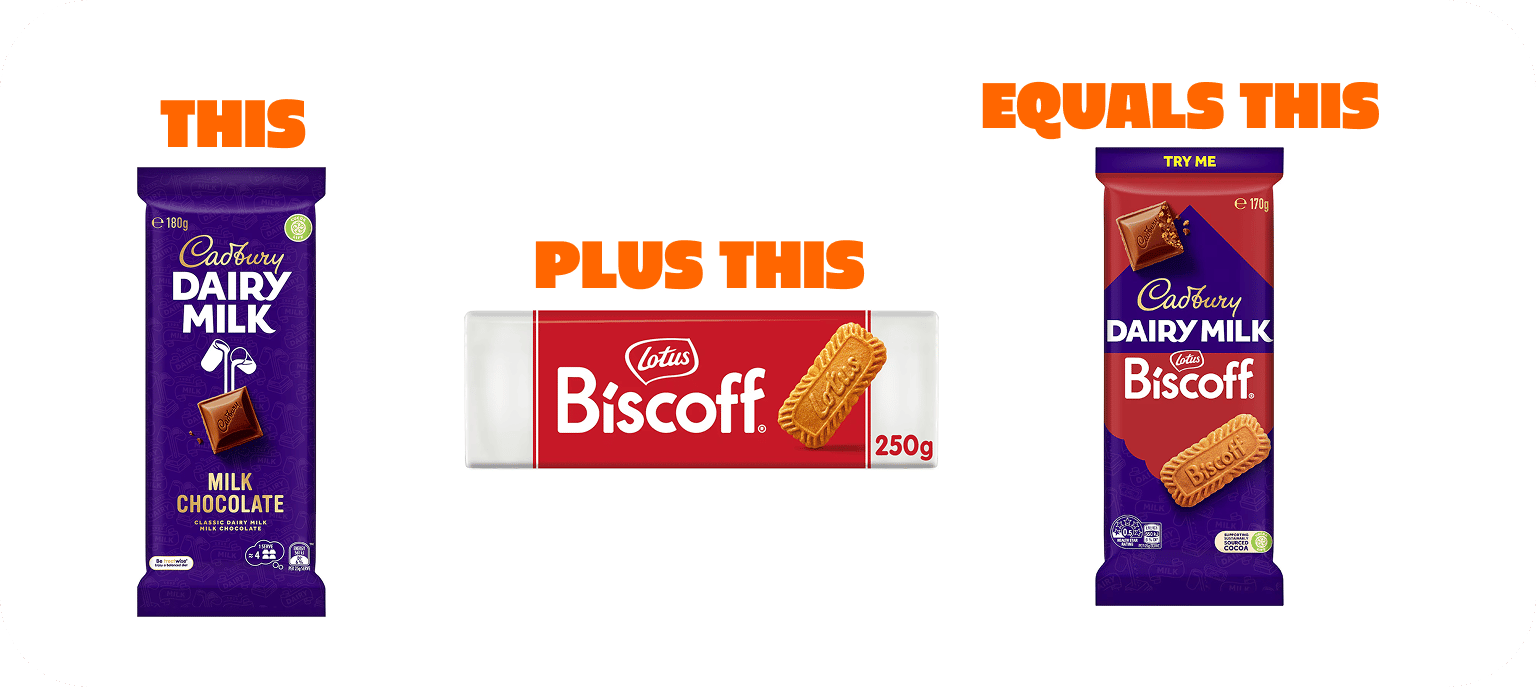
Source: Cadbury/Biscoff
Any brand can launch a ‘caramelised biscuit chocolate’ but there is only one Biscoff. This is basically a cheat code because the mental model already exists: “chocolate block + iconic crunchy biscuit flavour.”
It went viral because the product promise is instantly understood.
4. Every pack needs a hero
Equal weight can get messy. One brand should lead, the other should endorse. Otherwise you’ll dilute both.
The easiest shortcut to decide is the format - is it a chocolate flavoured biscuit or a biscuit flavoured chocolate?

Source: Leggo’s and Umami Papi
The other consideration here is leverage. Which brand has more weight and who’s got the greatest leverage in the partnership? In the case of Leggo’s and Umami Papi, Leggo’s is a legacy brand that’s been around forever and Umami Papi is a growing startup. It makes sense for Leggo’s to lead here.
5. Be honest about leverage
Every brand wants to partner with a brand bigger than them because of the associated benefits. Are you borrowing equity or distribution? Sometimes you’re renting credibility, sometimes you’re renting shelf space, sometimes you’re renting hype.
Whatever it is, be clear about it and acknowledge it. A smoother partnership will flow when everyone is clear about what they’re giving and taking.
6. The long-term memory structures
If the collab teaches consumers the wrong thing about you, you’ll pay for it later.
Short-term attention can be an expensive way to train the market to misunderstand your brand. It sounds obvious, but don’t jump on a collaboration in a category that clashes with the core elements of your brand
You’re paying for short-term attention with long-term confusion.
7. You must make money
The novelty will wear off, you’ll have excess stock, smaller MOQs, special ingredients, extra QA and a collaboration that murdered your margin. So you can’t model this like a PR stunt, it needs to act like a real SKU (because it is).
8. Speaking of money, who’s paying?
Real collaborations win when they gain incremental shelf space, off-location placements and a nice little kick from trade partners.
But retailers don’t range “cool”. They range a commercial story.
Decide who pays for intro deals, promo, sampling, retailer media, features.

Source: Vacation & Pepsi
9. You need an exit plan
If it flops, who wears the stock? What if the partner gets into a messy PR scandal, do you have an exit clause. No one wants to think about the breakup, but adults do.
10. Build a platform, not a one-hit wonder.
A great collab can become a repeatable innovation pipeline. A bad one can become a dusty limited edition that everyone pretends never happened. Decide your fate.
The one thing that matters most: the product
Here’s my hot take: if the collab doesn’t make immediate sense, you’re relying on novelty to do the selling.
Novelty is a sugar hit. Winning products are like compound interest.
What do you think? Got a collab in the pipeline?
What did you think of today's story?Click to vote, it helps us improve. |
Reply